
The "New Truck" Trap: A CPA’s Guide to Smart Year-End Spending
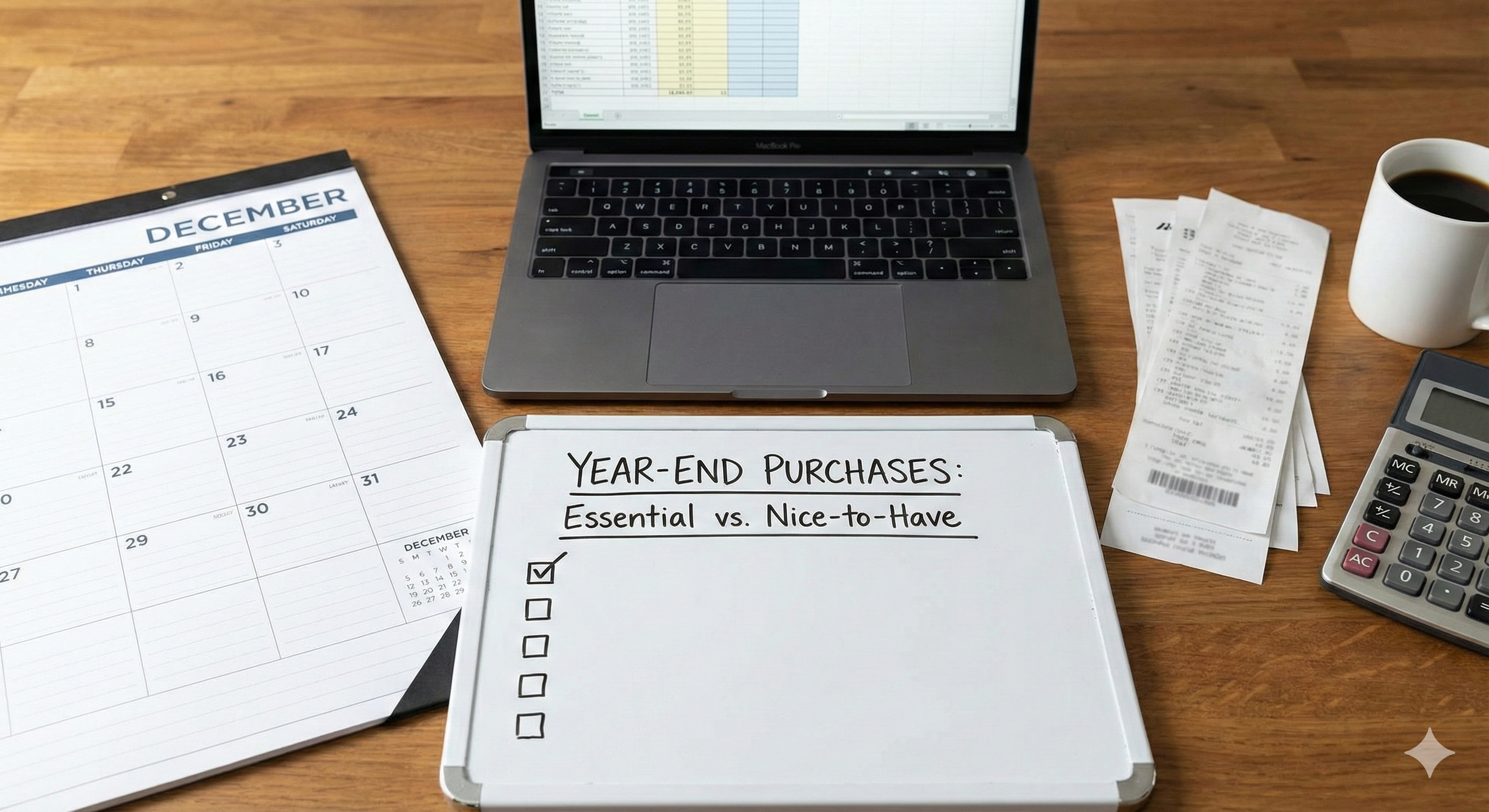
December 2, 2025
If it won’t make you more money next year, the deduction isn’t worth it. Smart investments first. Tax savings second.
It is December 2nd, 2025. My phone is ringing, my inbox is filling up, and the question of the hour is almost always the same:
"I’m showing a profit this year. Should I go buy that new truck/server/excavator to lower my tax bill?"
I call this "The December Itch." As business owners, you see that net income figure on your P&L, you visualize the check you’ll have to write to the Treasury in April, and you panic. Suddenly, the local dealership lot looks like a tax haven.
As your CPA, I am here to tell you: Put the checkbook down.
At least for a moment.
While I love reducing your tax liability as much as you do, I hate seeing clients make bad business decisions in the name of tax avoidance. Before you rush out to make a major purchase before December 31st, let’s look at the real math behind the "write-off."
The "Spending a Dollar to Save 30 Cents" Fallacy
There is a common misconception that a "write-off" means the item is free. It isn't.
Let’s look at the mechanics. Thanks to Section 179 and Bonus Depreciation (which sits at 40% for 2025), you can indeed write off a significant portion, sometimes all, of the purchase price of qualified equipment or heavy vehicles (over 6,000 lbs) in the year you buy them.
But here is the math equation you need to remember:
If you are in the 24% tax bracket and you spend $50,000 on a piece of equipment:
You reduce your taxable income by $50,000.
You save roughly $12,000 in taxes.
The Net Result: You have $50,000 of new stuff, but you have $38,000 less cash in the bank.
If that equipment doesn't help you generate at least $38,000 in new profit over its lifespan, you didn't save money. You just spent it.
My 3-Question Test for Year-End Purchases
Before I give a client the green light on a December purchase, I ask them these three questions. If you can’t answer "Yes" to all of them, keep your money.
1. "Would you buy this if there were zero tax benefit?"
This is the most important filter. Tax deductions should be the reward for a good business decision, not the driver of it.
Is your current truck breaking down and causing missed deliveries? Buy it.
Do you just want the heated seats and the newest model? Wait.
2. "Can your cash flow survive the 'Q1 Hangover'?"
December is often a high-revenue month, so you feel flush with cash. But I know your books. I know that for many of you, January and February are slow.
If you drain your operating account now to buy equipment outright, will you have enough liquidity to cover payroll, rent, and quarterly estimates when revenue dips in six weeks? I would rather you pay a little more in taxes but keep a healthy cash buffer for the winter months.
3. "Is the asset 'Placed in Service'?"
This is a technical IRS rule that trips people up every year. To take the deduction in 2025, you cannot just pay for the item. It must be in your possession and ready to use by December 31st.
If you order a custom truck today, pay for it in full, but it doesn't get delivered until January 5th, 2026? You get zero deduction for 2025. Be very careful with supply chain delays if you are cutting it close.
The Bottom Line
Don't let the "tax tail" wag the "business dog."
If you need the equipment to grow in 2026, let’s make it happen. We can run the numbers to see how the depreciation will impact your return. But if you are only buying it to spite the IRS, you are likely hurting your own business more than the government.
Still on the fence?
Don't guess. Call the office this week. We can look at your draft P&L, project your tax liability, and see if that purchase actually makes sense for your bottom line.
Written by Kindled Planning: Light the way to your financial future.
A CPA-led personal CFO service helping families and business owners make confident, tax-smart financial decisions, without losing sight of what matters most.
